
The Two Buddhas

This past summer, my family and I returned to Provence five years after selling our beloved olive farm. It was meant to be a holiday, but I suspected that we were all seeking either closure or confirmation.
The last time I had set foot here I was a different person — dividing my time between London and Provence, working in finance, and thoroughly embracing all the trappings of that life. Now, I live in a small town in America and write in obscurity. It’s a shift that still surprises me. And during these past five years, much of the scaffolding of life that by my age should have been secure, had slowly unraveled. On top of the emotions surrounding this “homecoming”, I was also feeling fragile, anxious, and uncertain.
We rented a house on “the other side of the mountain” – in a part of Provence where we had not spent much time. This was the “posh” Provence. The Provence of the movies. The Provence of Peter Mayle. Beautiful, with its quaint villages and manicured fields, and this time of year, heaving with tourists.
I had just finished the 1st draft of my book and was looking forward to some time to decompress. I was determined to let go of schedules and obligations. No plans. No agendas. No quick re-reads of the draft. I would just allow every day to emerge with its own unique rhythm.
On our second day, we decided to go exploring. We needed to get away from the crowds. With uncharacteristic boldness, we threw out the maps, cranked up the music, and just followed the road – a long, winding road – that took us into a wild and uncharted landscape we had no idea existed.
At some point, we ended up in Sault, near the summit of Mount Ventoux. This is the Tour de France part of Provence where amateur cyclists abound. We stopped to stretch our legs and noticed a market in the village center. It was clearly intended for tourists and since we were now, in fact, tourists, we decided to take a look.
There were maybe ten stalls – most hawking antiques that had seen better days. I quickly lost interest and wandered over to a bench at the edge of the square. As I passed the last stall, I immediately felt an unmistakable pull. A force that literally made me stop dead in my tracks. It was not an audible voice that said, “stop!”, but it was close. Really close. I tried to ignore the sensation, but it only grew louder.
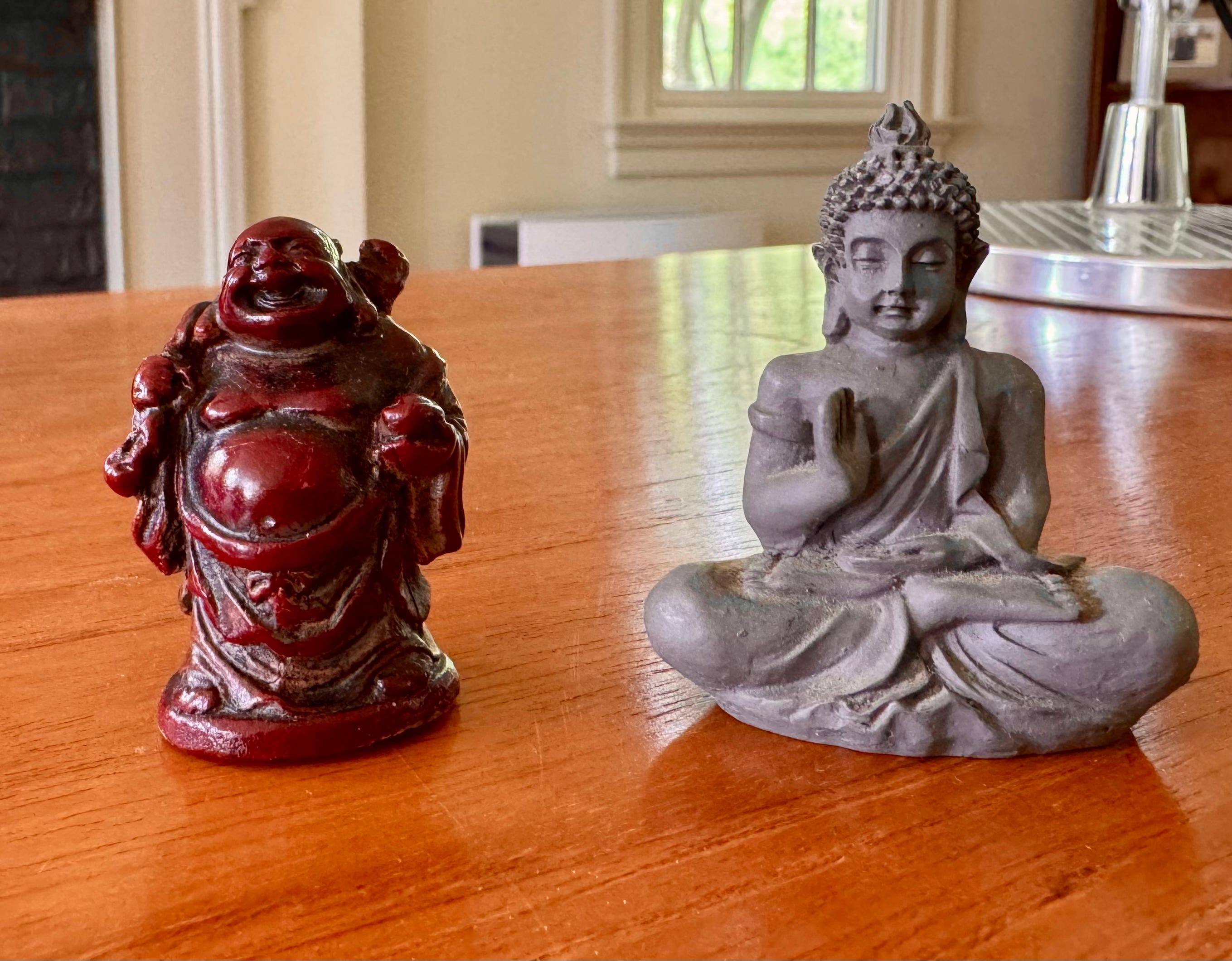
I glanced over at the table. It was littered with “tat” – a random collection of things once cherished and now forgotten. But amidst the chaos, my eye was drawn to two small statuettes. And when I say “drawn”, I mean it. It was like they had some supernatural glow that made them stand out from the rest. One was the Budai, or the Laughing Buddha, and the other was a Buddha in Abhaya Mudra.
I vaguely recognized the mudra, but I could not recall its meaning. And I had absolutely no context for the “laughing buddha”. It reminded me of something I once saw in a Chinese restaurant in a strip mall. Why I felt drawn to these two statues was beyond me. Neither was particularly stunning or memorable. In fact, they were both caked with dust and their features worn with age. But the sensation was unmistakable. I knew they were meant for me.
I bought them. And as the woman behind the table handed them over, with what I could have sworn was a wink and a smile, the sensation was immediate: immense calm and utter joy. I was astonished. Beyond astonished, almost terrified by the intensity and suddenness of it all.
At that moment, I somehow knew, without a shadow of doubt, that these statues contained a specific message. A message meant for me. A message for this very moment. Nothing, and I mean nothing, like this had ever happened in my life. It was what the mystics of old might call an experience of the divine.
When we returned to our house, I discovered that the Budai represents joy, abundance, childlike play, and contentment. And in his sack he brings sufficiency while carrying away troubles. The Abhaya Mudra means fearlessness and protection. Taken together their message was something like, “Relax. Let go of your fear and worry. Everything will be fine. Laugh, sing, and play because you are protected.”
The trip ended up being one of the most significant we had ever taken as a family. We were all engaged, relaxed, light, and happy. It was a gift. And I am certain that my “finding” the Two Buddhas on Mount Ventoux had something to do with at least my own rhythm during that week. I went from being anxious and uncertain to being seen, heard, and protected. It was a monumental experience.
The statues now sit on my desk and stare at me as I write. I can’t say that my anxiety and uncertainty have completely dissipated. But whenever I see them and recall this experience, my shoulders immediately drop, my breath slows, and for a moment I feel what some might call contentment.
Some believe icons such as these contain real power and maybe they do. However, for me, their power rests in their message. A message of hope. A message of faith. A message that courage and contentment go hand-in-hand. A message that support is ever-present and often arrives in the unlikeliest of places.
Let's go!!!