
How to Feel Something You've Never Felt

In November of 2022, I acquired the option on Peter Mayle’s book, The Vintage Caper. The idea was to write a spec script and try to sell it as a television series.
I was an inexperienced writer. Before this, my writing had been limited to occasional investor updates and inconsistent journaling. I had spent decades analyzing risk and probabilities, so I knew the odds were long. But for some reason, likely a combination of misplaced confidence and naïveté, I rationalized this risk away. I had a dream, and I was determined to realize it.
Soon after acquiring the rights, a friend introduced me to Ileen Maisel—a producer who had been in the film industry for decades. The purpose of the meeting was to pick her brain, get some advice, and maybe even a sanity check. I was floored when she decided to take a chance on me.
For the next fifteen months, I wrote as if possessed—hours upon hours of typing and retyping. When I wasn’t writing, I was dreaming of Hollywood glory: television premieres, fancy parties, and hanging out with all those interesting creative types.
I produced multiple drafts. Each one getting progressively better. Each one trying Ileen’s patience. I thought we were close.
Then, Ileen died.
She had been ill for months—though she hid it well. It was difficult to wrap my head around the fact that I would no longer hear her laugh, field her pointed questions, or simply bask in the glow of her presence.
Our meetings always happened at the same time—breakfast. And at the same place—Claridge’s. And at the same table. The very table where she had met with a veritable who’s who for over three decades. Ileen was such an institution at Claridge’s that within days of her death, management placed a brass plaque at the foot of “Ileen’s table.” It reads:
Ileen Maisel held court here from 1988-2024.
A Pioneer Producer in International Film Productions.
A true original as a person and a creative force.
Respected and beloved friend to her artist community.
Her family and Claridge’s family will miss her always.
Sometimes, when I am back in London and find myself in Mayfair, I make a quick detour to glance at that table. I can still see Ileen asking the staff, who she knew by name, about their kids’ soccer games, exam results, and recent holidays, all while critiquing the scene I had written with painfully sharp observations. But always with a smile.
After reeling, I finally managed to pull together a half-hearted final attempt at the screenplay. Then, in March of 2025, I got a call from Mayle’s literary agency. They were not going to renew my option on the book. It was a blow, and a significant step backward professionally.
I once asked Ileen if I was crazy for trying to become a writer after spending two decades in finance. She looked at me as if the question were as daft as the questioner. First, she said all writers were a bit crazy. Then, she asked if I was writing every day. I said that I was. And she said, “Well then, you are a writer.”
I smiled politely at her encouragement, but without money flowing into my bank account, it didn’t seem like a real vocation. Still, it was all I had. I had closed the door on my previous life. At this point, there was no going back. I was determined to keep writing. If nothing else, it seemed a fitting tribute to this woman who had faith in me.
Most of my friends thought I was foolish. They didn’t say it to my face, but I could see it in their forced smiles accompanied by the practiced, “How’s it going?” I knew what they really wanted to say: “You need to get real. Be responsible. Go back to finance while you still have the chance.” Part of me suspected they were right, especially now that my only champion was gone. But I willingly shut down the rational part of my brain, or more accurately, ignored it, and pressed on.
I went back to my desk, set a timer for four hours, and began to write. I had no direction. No outline. No agenda. But within the first few minutes, stories spilled out: stories from my own life and the lives of others. This continued for the better part of two months.
When I finally stopped, I had about 65,000 words. I didn’t know if they were any good. I had no idea if there was any sort of interesting thread. And I certainly had no expectation that these words would lead to anything tangible.
My first reading only reinforced that expectation. About 70% was complete rubbish. Yet, the remaining 30% had something. What, I wasn’t sure. But I knew it was worth hanging on to.
Still, at that moment, I was certain that I didn’t have a book in me. The idea of writing hundreds of pages, tens of thousands of words, that together formed an intelligible, much less articulate, narrative, was not just daunting; it was laughable. My friends knew it. I knew it.
I had done what Ileen suggested, but now I didn’t know what came next. And she wasn’t around to help.
It was at this point that the idea of visualization popped into my head. It was a weird thought. How could tapping into my imagination help me produce a book or anything tangible? I had been exposed to the idea in Gallwey’s The Inner Game of Tennis and Rubin’s The Creative Act. Elite athletes and artists swore by it. Yet, it seemed desperate. It was desperate. But I thought: what the hell, maybe it could help.
So, each morning I carved out 5-10 minutes to visualize writing. Not just the act of typing but the whole thing: holding the finished book in my hands, people’s reactions, the book in a bookstore. I even imagined those days when I’d struggle to write anything at all.
For most of my life, no matter the endeavor, I have attributed my results to one input: time spent in physical effort. It was the hours spent at my desk or on the tennis court that were, in my mind, what produced the results. The formula was simple: effort over talent.
Visualization would require effort, so under this model, I absolutely expected it to do something. It was similar to the mental exercise I would perform during my commute to the office—where I would play, and replay, the various scenarios that could impact the outcome of the investments held in my hedge fund. But that “visualization” was different. Driven by obsession and fear rather than by a desire to bring about a specific outcome.
But there was a problem: I didn’t have any idea what being a published writer would actually feel like. Neville Goddard had said, “The feeling is the secret.” Not helpful. I could picture the scenes, but I couldn’t get to the feeling.
I struggled for weeks to manufacture that feeling. And I failed. Every day. As soon as I would call up the image of, say, my book in a bookstore, immediately my analytical mind would run a list of ten reasons why that would never happen. And suddenly the visualization turned into an argument. I could feel my heart racing. My mind going into overdrive as it wrestled with different probabilities—just like I had done for years in finance. The feeling wasn’t the secret; optimizing outcomes was.
But I couldn’t optimize this. I had no contacts in the publishing world. I had no platform. I didn’t even know if I could write anything worthwhile. I couldn’t shake the idea that I was deluding myself. Grasping at straws. A desperate middle-aged man who should know better than to play games.
I was frustrated. I cursed both Gallwey and Goddard. I think I actually told my wife that it was all bullshit. I could hear the manifesting crowd telling me that I had not given it enough time. But I didn’t have the luxury of years to test an esoteric theory. I needed to earn.
My mind was screaming that the entire approach was bonkers. I was at a loss. So, one morning rather than forcing more visualization, I decided to go for a walk to clear my head.
It was early and quiet. The sun was just creeping over the horizon. I took a familiar route. My body knew what to do and where to go, which allowed my mind to roam. And I mulled the problem over: how to find the feeling of something I had never felt. I couldn’t accept the possibility that others had some sort of skill or ability that completely eluded me. There must be a solution.
About halfway through that walk, a thought hit me—why couldn’t it be any feeling?
Holding my finished book would bring elation, relief, and satisfaction. What if I dove into my history and extracted experiences that had yielded exactly those emotions and layered them onto the imagined scenes about my book? No one had said the feeling had to be specific. Why couldn’t I borrow the feeling?
I stopped walking. Would that even work? Taking a feeling from a wholly unrelated experience and ascribing it to something I hoped would happen in the future. It seemed a strange idea, but it also felt kind of right.
I raced home. Went into my office. Collapsed into my chair. Closed my eyes. And called up the memory of holding each of my daughters for the first time. I felt all the emotions—the disbelief, panic, gratitude, and most importantly, the joy—as if I were reliving the experience in that moment. I quickly formed the image of my book in the bookstore while holding on to that feeling.
Then it was over.
I opened my eyes and glanced around the room. I don’t know what I expected to happen. Maybe not fireworks or trumpets, but I certainly expected… something to happen. But everything looked exactly the same. I felt exactly the same.
By this time, I was questioning my own sanity. The notebook where I had recorded all the rational reasons why I could not write a book loomed large on the desk. But I couldn’t walk away. It would feel like giving up. And I was not a quitter. Besides, Ileen was in my head. I could hear her saying, “Don’t overthink it!”
So, I doubled down. Armed with my new method—the borrowed feeling—I continued the practice.
There was a lot of inconsistency. Some days my rational mind was simply too loud. And there were weeks when I would give up entirely due to the lack of any indication that it was working. The truth was that on most days, my imagination was consumed not by what I hoped, or dreamed, would happen, but by what I didn’t want to happen.
But occasionally, I was able to step out of that loop and capture the feeling of something more. If nothing else, it was an enjoyable experience. For that reason alone, it had value.
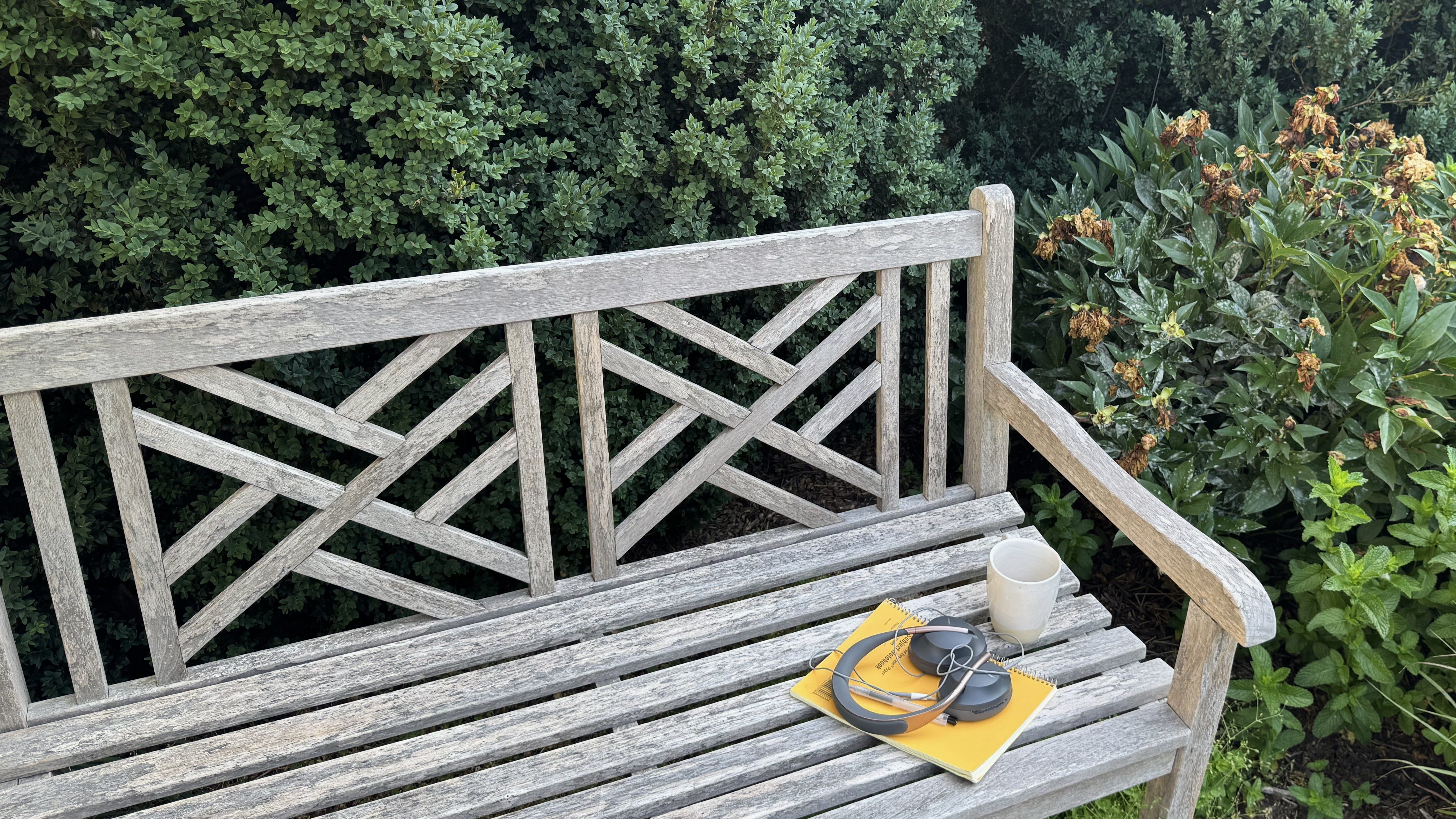
On a recent morning, I went out to the garden, coffee in hand, to listen to an audiobook. I sat on my favorite bench, slipped on my headphones, and pressed play. Within moments, I was lost in the rhythmic narration.
At one point I thought, “That was a great line, I should write it down.” I stood up, in a sort of daze, to go inside and grab my notebook. I thought, “Man, I wish I could write a book like that.”
I had barely moved toward the house when one of our cats leaped out of the bushes behind me in pursuit of a bird. I nearly spilled my coffee.
Holy shit. I had written those words. This was my book.
For a moment, I wondered if I had landed in some parallel universe. Sure, I had spent the hours writing. And I had visualized the finished book. But I hadn’t visualized this. And now, standing in that garden, completely bewildered, I was incredulous—did simply holding that feeling for a few minutes a day, a feeling which had nothing to do with writing, actually shift my reality?
I glanced around hoping there might be a witness or at least someone who could provide an explanation. Or better yet, someone with whom I could share my bewilderment. But I was alone. And confronted with a choice: I could give in to my logical mind and rationalize it all away, or I could acknowledge what I felt—that something mysterious had occurred.
The rationalist was fighting hard. It wanted me to do what I had done for most of my life: face uncertainty, resolve it, and move on. It’s what made me a pretty decent investor. But in that garden there was nothing to do. I couldn’t prove that my visualization had impacted my reality, but I also couldn’t disprove it. And that tension, or the inability to resolve it, was the most unsettling part of the experience.
While I wouldn’t go so far as to say that I felt Ileen in that moment, I could see her look as clear as day. A look that said, “Well, of course, what did you expect?”
'Man, I wish I could write a book like that.' I love that - its a rare feeling of contentment, to appreciate your own work after the fact.
so sorry about your friend.
Bravo on your book. I loved it and passed it on to Andrew!
Happy writing!