
Culture and Belief

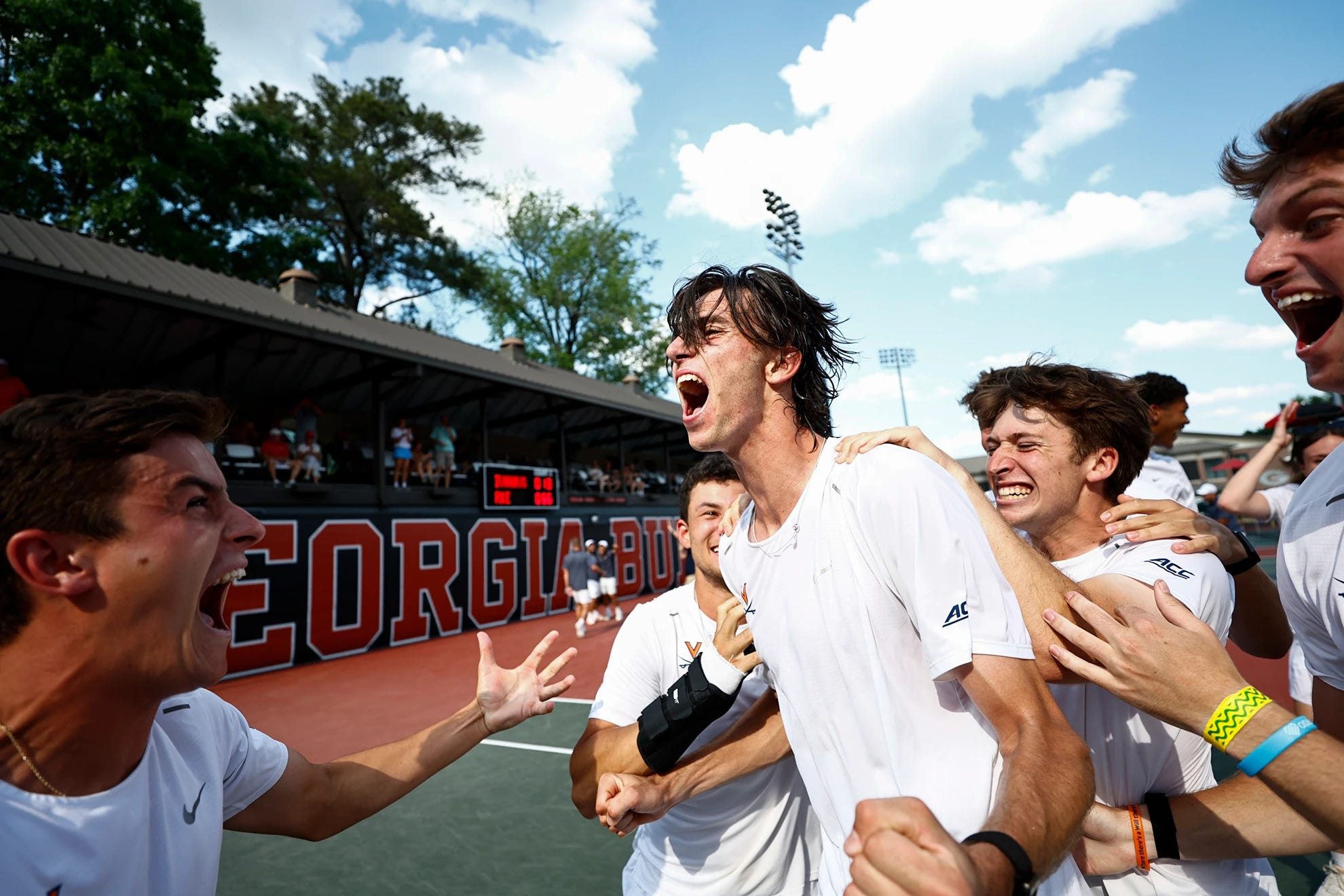
Dylan Dietrich, a junior at the University of Virginia and the #1 college tennis player in America, took a moment to compose himself. He was down a break in the deciding set of the deciding match to determine which team would win the NCAA National Championship.
Across the net was the #3-ranked player in the country who, at that moment, had all the momentum. The match had been a battle—a back-and-forth affair with almost no margin of error. Technically, the players were equally matched. Both were struggling with the heat. Both were feeling the weight of the moment. Neither wanted to let down their teammates, coaches, and fans. It was the sort of situation that tennis players both dread and dream about.
Dietrich and the rest of the team had played inspired tennis over the past ten days to arrive in this moment. They were the #4 seed—a strong team, but not expected to be a contender, especially after their #1 player, Rafael Jódar, had joined the pro tour only days before the start of the season. They were not as deep as the other teams. And they were arguably less experienced with a freshman and three sophomores in the main lineup.
Yet here they were—points away from the unthinkable. After crawling out of a deep deficit in the semifinals to upset the defending champions and the #1 team in the country, they were tied 3-3 with the #2 team in the country.
But being down a break in the third set was far from ideal. The score was 3-1, Dietrich’s opponent was serving, and it was deuce. There are no ad points in college tennis, so this was the moment. This was the point on which everything hinged. If Dietrich lost this point, it would take a miracle for him to win the match. In fact, one could argue that to win this particular deuce point would take its own miracle—something more than talent, technique, or even brilliant coaching.
It would take belief. Or self-belief. Not a belief in what he could do—a belief in who he was. An ability to set aside the external reality—to transcend his nerves, pain, and the weight of the moment—and call upon something intangible.
Everyone in the stands, everyone watching the live stream, and all the players and coaches could feel the tension. Everything went quiet as the players took their positions. The only sound—his opponent bouncing the ball and Dietrich’s own rhythmic breathing as he awaited the return.
And suddenly, the serve was on its way. It was a rocket. Dietrich just managed to make contact. His opponent crashed the net. He had the advantage. Dietrich was on his back foot—just trying to stay alive. They exchanged two balls. Then, Dietrich got a forehand. A floater—the sort of ball that on any other day he could execute in his sleep, but which, in a moment such as this, becomes loaded.
Everyone held their collective breath. This was it. The point of the match.
And Dietrich hit a perfect shot—a winner. His teammates leapt into the air. He was still alive.
Then, he held serve and broke his opponent again. Two games later, he won the match.
UVA had won the national championship for the seventh time since 2013.
In his post-match interview, Dietrich didn’t point to technique or training as the differentiator. He pointed to two things: mentality and the people around the court. And the two were linked. His ability to remain calm and focused came from what he received from the crowd, his teammates, and the coaches in that moment. What he received was a reminder of something bigger than a tennis match, and that reminder allowed him to access the belief necessary to propel him to victory.
Tennis is a solitary sport, arguably the most solitary of sports. And in the most solitary moment of the most solitary sport, when it must have felt like he alone was carrying the weight of all the hopes and dreams of his teammates, coaches, and fans, Dietrich was not actually alone.
I didn’t attend UVA. Nor am I what could be called a die-hard sports fan. I am an ex-tennis player who stumbled upon the team soon after moving to Charlottesville five years ago. Their facilities are near my house. And one day, when I was out running an errand, I noticed a line of cars pulling into the facility. On a complete whim, I decided to take a moment and see what the fuss was about. My plan was to stay for maybe 10 or 15 minutes. But from the moment I first took my seat in the stands, I could sense that something was different. There was an unusual energy.
Sure, the players were exceptional. The facilities were exceptional. And the fans were rowdy. On the surface, it resembled every other elite college tennis program in the country. But it was different. You could feel it in the air. There was an aura. This place was special. A specialness that was hard-won.
Later, I came to understand that what sets this program apart is what people call “culture.” That is an overused word in sports today—a sort of catch-all phrase, often said tongue-in-cheek, meant to communicate that the coaches, players, and fans care about more than trophies and titles. But for the tennis program at UVA, it is not just a word. It is everything.
It translates into a deliberate decision to pass on the most hyped junior players to recruit the rougher, maybe even immature, players whose presence may not guarantee a title—who might even buckle the first time they experience the pressure that is college tennis—but who fit with the culture. To select a player not because of his talent, but because of his attitude. When the careers of college coaches are dependent almost entirely upon titles and wins, selecting for something intangible doesn’t just seem strange, it seems entirely foolish.
And yet, what has been created in the process is the sort of place where a player experiences the same joy and applause for earning a 3.7 GPA as they do for winning a title. A place where a player can leave just before the season to turn pro, have an extraordinary few months that catapult him into the top 30 in the world, and yet who still texts his old teammates daily and intensely follows their season. And who, when asked in an interview about his time at UVA, said it was the best year of his life.
For me, the turning point of this season—the moment I actually believed that these guys could win the championship—was during their 2nd round match against 26th-ranked Columbia. UVA were expected to win. They were the higher-ranked team and had home-court advantage.
But Columbia came out of the gate fighting. They took the doubles point, putting UVA on the back foot from the outset. And an hour into the match, Virginia had lost the first set on five of the six singles courts. Something special would need to happen for them to find a way to win. You could feel the tension in the stands—it was as if we all could sense the incredible mountain the team would have to climb to keep their title chances alive.
But then, that something happened. The player on court four, a sophomore from South Korea, found another gear. He played inspired tennis and won the second set. And you could immediately feel the domino effect. The player on court three fist pumped at his teammate and then lifted his own play—stringing together four consecutive games to take his second set. The screams of “come-on” and “let’s go” began to reverberate across every court. The fans were on their feet.
I was focused on the coaches. I leaned in—wanting to hear what magic words they were imparting to the players in this moment. I expected footwork, serve placement, or even strategy. What I heard was something like: “remember who you are” and “remember who this team is.”
At first, I assumed they were calling on the players to remember past players, past glories, and even familiar moments. Then I realized they were talking about something deeper. Sure, to remember the work—the long days of training that carried them to this moment. But I also think they were alluding to all the memories built off the court—in the locker room, joking over pizza, the quiet moments when no one was watching. They were being called to remember not what they were doing, but who they were.
At deuce, 3-1 down, and returning serve, Dietrich couldn’t tap out. No one could hit the ball for him. What he called upon in that moment was something he had built with his teammates throughout the season—a belief that surfaced exactly when he needed it most—because he hadn’t built it alone.
A skeptic could argue that Texas and all the other teams that have competed at this level have culture too. That the actual variable was Dietrich hitting a forehand winner on that deciding deuce point. Fair. The question isn’t whether he could hit the shot. He has hit it ten thousand times. The question is what allowed him to execute it in that moment.